
CoQ10 and Mitochondrial Energy Production
What CoQ10 does in your cells, how the two forms differ, and practical tips for older adults and statin users.
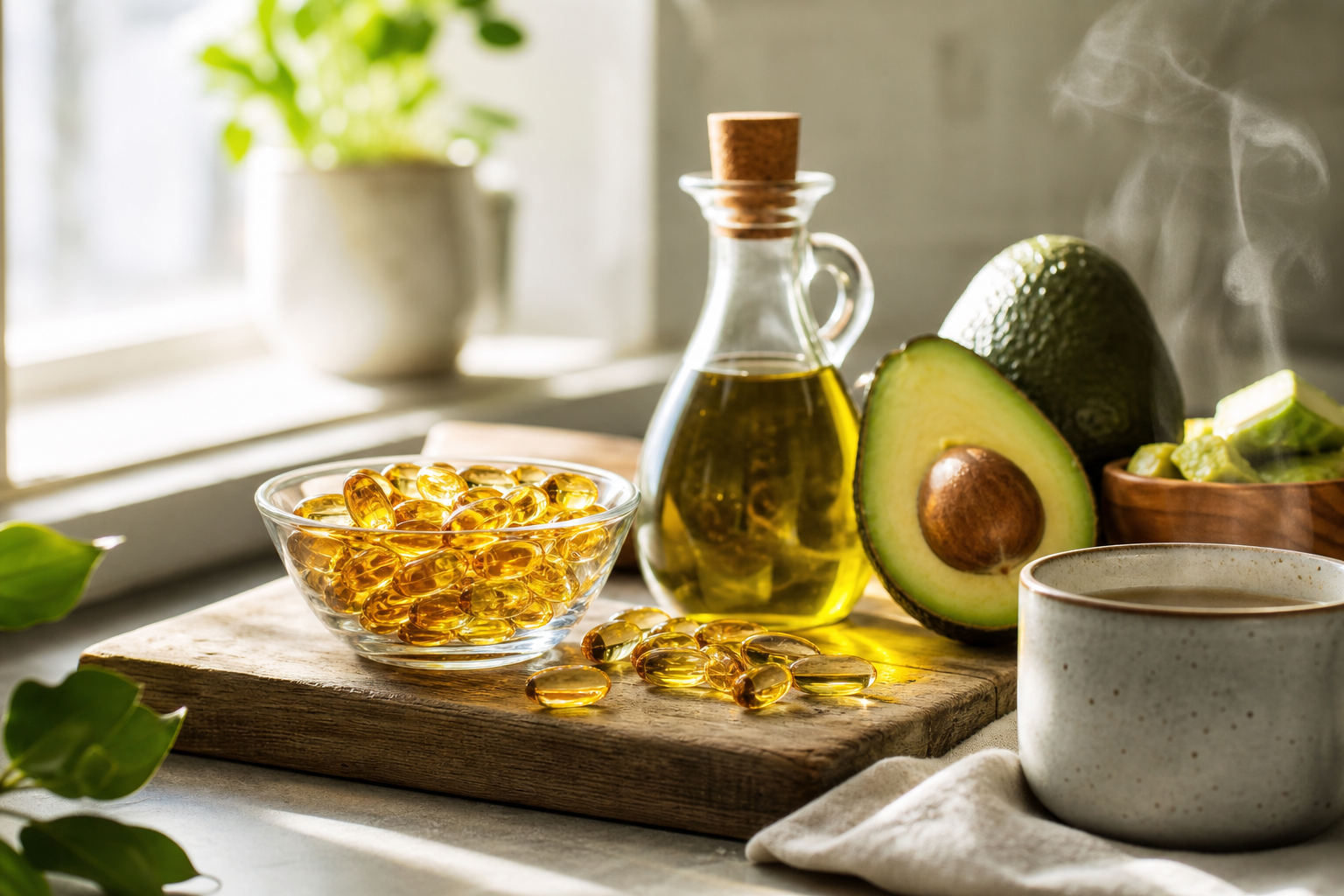
- CoQ10 helps shuttle electrons in mitochondria, supporting ATP energy production.
- Ubiquinol and ubiquinone interconvert in the body; formulation and taking with fat often matter more than form.
- Statin use is associated with lower circulating CoQ10; supplementation helps maintain normal CoQ10 status.
- Tissue CoQ10 tends to decline with age, so consistent, well-formulated CoQ10 may be more important over time.
CoQ10: Your mitochondria’s courier for energy and resilience
Coenzyme Q10 (CoQ10) is a fat-soluble molecule that sits in the inner membrane of mitochondria, where most of your cells’ ATP—the chemical energy that powers daily life—is produced. Its job is elegantly simple: ferry electrons between complexes I and II to complex III in the electron transport chain, a step that helps drive ATP synthesis. Without adequate CoQ10, that flow of electrons is less efficient, and cellular energy production can lag. Beyond energy, CoQ10 also serves as a local antioxidant in membranes, helping to stabilize lipids and proteins exposed to high-energy reactions inside mitochondria [1].
In practical terms, supporting healthy CoQ10 status can help your cells keep up with day‑to‑day energy demands, especially in tissues with big energy budgets like the heart, brain, and skeletal muscle. The body can make CoQ10 on its own, but nutrition, genetics, age, and certain medications can influence how much is available. Dietary sources exist (oily fish, organ meats), but typical intakes are modest compared to what’s used in supplementation research. That’s why CoQ10 has become a go‑to nutrient for people focused on cellular energy support and oxidative balance [1],[5].
Ubiquinone vs ubiquinol: Different names, same cycle
CoQ10 appears in two main forms in supplements: ubiquinone (oxidized) and ubiquinol (reduced). Inside your body, these two forms constantly convert back and forth as part of normal metabolism—the very reason CoQ10 can move electrons and buffer oxidative stress. After absorption, the form in circulation is predominantly ubiquinol under normal conditions, regardless of which form you swallowed. This interconversion is a key point often lost in marketing [1],[5].
So, does one form absorb better? The honest answer: it depends less on the redox form and more on how the product is made and how you take it. CoQ10 is lipophilic and bulky, which makes absorption tricky without help. Oil-based softgels, proper solubilization, and taking CoQ10 with a meal containing fat can substantially improve uptake. Systematic reviews and pharmacokinetic studies suggest that formulation and co‑administration with dietary fat are consistent drivers of bioavailability, with both ubiquinone and ubiquinol performing well when appropriately formulated [2],[6].
You’ll see claims that ubiquinol is always superior, but head‑to‑head data are mixed. Some trials favor ubiquinol in specific contexts, while others show that well‑designed ubiquinone formulations match or exceed it. For most people, picking a reputable, oil‑based product and taking it with food is more actionable than fixating on the label’s redox term. If you’ve tried one form without the results you expected, switching to a different, well‑formulated product—rather than simply changing redox form—can be a practical next step [2],[6].
Age and CoQ10: why older adults may need smarter support
Your body synthesizes CoQ10 via the mevalonate pathway, the same pathway that produces cholesterol and other isoprenoids. As we age, the machinery that makes and recycles CoQ10 appears to slow, and tissue levels tend to drift downward—especially in energy‑hungry organs. Classic tissue analyses reported lower CoQ10 content with advancing age in human heart and other tissues, suggesting a gradual decline in the very places that need it most [4].
Lower tissue CoQ10 doesn’t automatically mean low blood levels, and there’s no single “deficiency” threshold for everyone. But the age‑related trend makes a case for paying attention to consistent intake and effective delivery in midlife and beyond. Some older adults also face more oxidative stress, which can increase turnover of ubiquinol back to ubiquinone; the body handles this, but it raises the stakes for steady availability. Taken together, a practical approach is to choose a proven, bioavailable CoQ10 product and use it consistently to help maintain cellular energy and membrane antioxidant support over time [1],[5].
If you’re comparing forms with age in mind, remember that the gut and bloodstream are oxidative environments, and CoQ10’s redox state will shift during digestion and transport. That’s not a problem—it’s part of how the molecule works. The bigger levers remain meal timing, lipid carriers, and overall formulation. Older adults may notice the difference most when they pair CoQ10 with a meal and select products that clearly state their solubilization method [2],[5],[6].
Statins and CoQ10: what’s the connection?
Statins work by inhibiting HMG‑CoA reductase, the rate‑limiting enzyme in the mevalonate pathway. That pathway doesn’t only make cholesterol; it also makes the isoprenoid side chain of CoQ10. It’s no surprise, then, that multiple studies have observed lower circulating CoQ10 levels in people taking statins. Supplementation reliably raises plasma CoQ10 in this context, helping to maintain normal CoQ10 status during therapy [3],[5].
What this does and doesn’t mean: CoQ10 supports cellular energy production and antioxidant functions; it is not a replacement for prescribed therapy, and it’s not intended to treat any medical condition. If you take statins (or any prescription), it’s reasonable to ask your healthcare professional about adding CoQ10 so you can coordinate timing and avoid unnecessary overlaps. From a practical standpoint, the same rules apply—use an oil‑based, well‑solubilized product with meals to support absorption [3],[5].
Because statin regimens and individual responses vary, there isn’t a one‑size‑fits‑all protocol. The steady signal across studies is that statin use is associated with lower plasma CoQ10, and that supplementation increases circulating levels. Keeping your attention on maintaining normal CoQ10 status and comfortable day‑to‑day energy is a grounded way to frame it [3],[5].
Choosing and using CoQ10 effectively
Two decisions drive results: the delivery system and your routine. Look for an oil‑based softgel that clearly describes its solubilization method (for example, emulsified or micellized in a carrier lipid). Pairing CoQ10 with a meal that contains some fat leverages normal digestive processes to carry this lipophilic molecule across the intestinal wall. Consistency matters more than chasing a perfect brand—your cells benefit from steady availability over weeks, not sporadic bursts [2],[5],[6].
Quality signals to consider include third‑party testing, an expiration date aligned with the product’s stability data, and transparent labeling of the CoQ10 amount and form. Storage is simple but important: keep it cool and away from sunlight. Because CoQ10 is fat‑soluble, some people prefer splitting their daily amount across morning and midday meals to support stable levels through the day. If you use other fat‑soluble supplements, spacing them out may help avoid digestive heaviness [2],[5].
Putting it together: a steady path to cellular energy support
CoQ10’s role in the electron transport chain is fundamental biology, not a trend. It shuttles electrons to help drive ATP production and buffers oxidative stress inside membranes—jobs that touch nearly every tissue. The redox labels on bottles (ubiquinone vs ubiquinol) reflect a dynamic cycle your body manages all day; the bigger levers for real‑world results are formulation, meal timing, and consistency. If you’re older or use statins, paying attention to CoQ10 status and delivery can be especially worthwhile. Aim for a well‑made product, build it into your routine with food, and give it time to do its quiet work inside your cells [1],[2],[3],[5].
FAQ
›Is ubiquinol better than ubiquinone?
Not categorically. Both forms interconvert in the body. Absorption often depends more on the product’s delivery system and taking it with a fat-containing meal than on the redox form itself [2],[6].
›Can I use CoQ10 if I take a statin?
Studies show statin use is associated with lower circulating CoQ10, and supplementation raises plasma levels. Coordinate with your healthcare professional so your overall regimen makes sense for you [3],[5].
›When should I take CoQ10—morning or evening?
Take it with a meal that contains some fat to support absorption. Many people prefer morning or midday with food to keep energy support aligned with daytime activities [2],[5].
›How long does it take to notice effects?
CoQ10 accumulates gradually. Steady use over several weeks is a reasonable window to evaluate how it supports your day-to-day energy and recovery [2],[5].
›Do foods provide enough CoQ10?
Diet contributes, but typical intakes are modest. Supplementation can help maintain normal CoQ10 status and support mitochondrial energy production when dietary sources are limited [1],[5].
References
- [1]Turunen M, Olsson J, Dallner G. Metabolism and function of coenzyme Q. Biochim Biophys Acta. 2004;1660(1-2):171-199. Source
- [2]Bhagavan HN, Chopra RK. Coenzyme Q10: absorption, metabolism, and pharmacokinetics. Free Radic Res. 2006;40(5):445-453. Source
- [3]Littarru GP, Langsjoen P. Coenzyme Q10 and statins: biochemical and clinical implications. Mitochondrion. 2007;7(Suppl):S168-S174. Source
- [4]Kalen A, Appelkvist EL, Dallner G. Age-related changes in the lipid compositions of rat and human tissues with special reference to coenzyme Q10. Biochim Biophys Acta. 1989;1004(2):171-178. Source
- [5]Hernández-Camacho JD, Bernier M, López-Lluch G, Navas P. Coenzyme Q10 Supplementation in Aging and Disease. Front Physiol. 2018;9:44. Source
- [6]López-Lluch G, Rodríguez-Aguilera JC, Santos-Ocaña C, Navas P. Bioavailability of Coenzyme Q10 Supplements Depends on Carrier Lipids and Solubilization. Nutrients. 2019;11(4):959. Source
Featured products
Editorially relevant — not paid placements.
Jordan writes about recovery, performance, and the science of feeling good. Former collegiate athlete, now obsessed with the small daily inputs that compound into long-term wellness.
Dr. Natarajan is a board-certified internist with a special interest in evidence-based supplementation and lifestyle medicine. She reviews Vitalytics content for medical accuracy.
Read next


The 5-minute briefing
One short, source-backed email each Sunday on sleep, energy, recovery, and daily wellness.